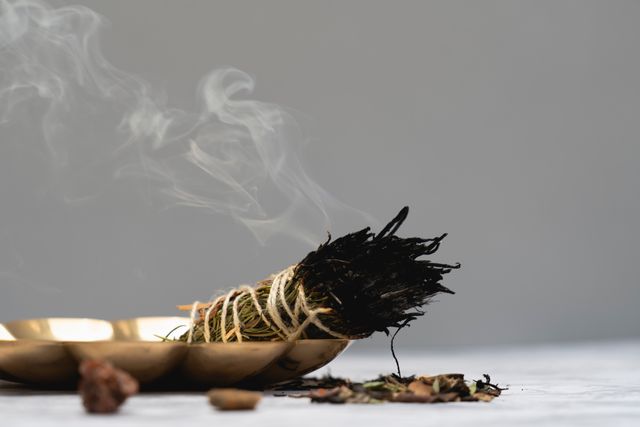
A well-known college basketball coach got attention the past two seasons when his superstitious practices were reported on the news. His office is filled with good luck/religious objects. He sometimes walks the basketball court before a game… doing a sage-stick ceremony (among other things).
Then into baseball season, a pro team had lost several games in a row. The radio announcer said that in order to turn things around in the upcoming game, the team might have to “get some sage or something.”
The sage-stick ceremony, also called smudging, sage burning, or smoke cleansing, is a well-known part of Native American culture, and there are similar uses in other cultures or religions too.
So what’s the big deal about burning sage? Don’t herbs/plants/flowers have benefits?
Let’s clarify. Yes, eucalyptus helps open Joe’s sinus passages; the fragrance of roses makes Lori feel good; the pesky ants in Darin’s kitchen don’t like cinnamon; and we eat sage in Grandma’s yummy Thanksgiving stuffing. Those physical, emotional, or “chemical” scenarios are natural. The key here is the intended use—what is the user seeking through this practice?
Some promoters of sage burning are thinking merely of superstitious good luck. Others speak in terms of clearing out so-called negative energy—for example, by walking through the rooms of a house in a certain order to cleanse it, perhaps leaving the sage on-site afterward for continued protection. Still others lean heavily into a spiritual purpose: removing or blocking “evil spirits.” (Note: Regardless of how the average person defines “evil spirit,” the Bible would equate an evil spirit with a demon.) Even Christians have gotten on the sage bandwagon, as mentioned in “That Gritty Feeling.”
As with most trends, the people caught up in this one don’t seem to have thought things through. For example, in the sports scenarios above, what happens if both teams burn sage? And the radio guy—well, maybe he meant that the home baseball team is so down on themselves after a series of losses, they need some kind of emotional boost; so he jokingly suggested that sage might shoo the team’s own depressed mindset (negative energy). If the idea is that sage gets rid of literal evil spirits/demons hanging around a game, well, it’d be interesting to hear the promoters’ deeper explanation. Like, is the opposing team demonic? What/Whose power is being invoked for help?
Whatever the expected benefits of sage burning, let’s see what Scripture says:
- Good luck. The Lord’s people don’t look to objects for protection or to get what they want. (Compare 2 Kings 21:1-9; Ezekiel 13:17-19.)
- “Cleansing negative energy.” Now yes, a room full of depressed or angry people might have what we’d call a bad vibe. If I personally have a negative attitude of hate, anger, bitterness, self-pity, etc., I need to deal with it directly. (See Galatians 5:22-25; Ephesians 4:22ff.) Confess it to the Lord, repent, recommit to his way. If friends are “negative,” we can offer sympathy, advice, help—and prayer.
- Ridding a place of a literal evil spirit/demon. My sarcastic side is thinking that since Hell evokes images of fire/burning, a demon would be comfortable with smoke! But seriously, we seem to have forgotten that “the name of the Lord is a strong tower; the righteous run to it and are safe” (Proverbs 18:10). “Do you not know? Have you not heard? The Lord is the everlasting God, the Creator of the ends of the earth. He will not grow tired or weary” (Isaiah 40:28). He doesn’t need help—he is the “very present help in trouble” (Psalm 46:1).
You may not be attracted to this particular practice. But let this be a reminder that we can easily fail to stop and evaluate a practice—especially if it’s one we’ve already accepted.
Just saw the perfect example of this. A Catholic believer asked a Catholic authority, “Is it wrong [for a Catholic] to burn sage to get rid of evil spirits?” The first part of the Catholic teacher’s answer was biblical. He said that, yes, this is pagan and might actually have the opposite effect. Right on! Using an object/ritual to make something happen is sorcery, which the Lord forbids. (Dabbling in sorcery can invite dark mischief.)
But then this teacher went on to suggest that the inquirer, instead of using sage, use a candle or a St. Benedict medal that has been “blessed by a Catholic priest” to get rid of the evil spirit. Sorry, but that’s sorcery too. The teacher ended up recommending the very kind of practice he was discounting! He has held his view for so long that, in my opinion, it’s hard for him to step back and rethink.
Let’s all step back. Let’s open the Bible to the passages above (and similar ones) and be thankful that the all-powerful Lord never needs a boost.